
Eliminate AR friction & reduce DSO: Read the AR Accelerator

Visa’s Commercial Enhanced Data Program: Impact on B2B Payments

How Fortis partners help businesses lower interchange through clean, verified transaction data under Visa’s Commercial Enhanced Data Program (CEDP)

Why B2B Payment Costs Are Rising, and What’s Changing

Many businesses pay more than they should for credit card processing—not because of their payment provider, but because of missing or incomplete transaction data. When details like invoice numbers, tax amounts, or purchase order information aren’t captured and transmitted accurately, transactions default to higher interchange tiers and costs rise. 

Visa’s Commercial Enhanced Data Program (CEDP), active since October 2025, brings those inefficiencies into focus. For the first time, data accuracy directly determines interchange cost, creating a clear incentive for businesses to modernize how they capture, validate, and submit payment data.

For ERP providers, software platforms, and their customers, CEDP turns payment data quality into a measurable financial outcome.

What Is Visa’s Commercial Enhanced Data Program (CEDP)

Visa’s Commercial Enhanced Data Program (CEDP) is a framework that links interchange rates for U.S. B2B and small business card transactions to the completeness and accuracy of transaction data. Businesses that submit verified, enhanced data qualify for lower interchange rates, while transactions with missing or inaccurate data incur higher costs.

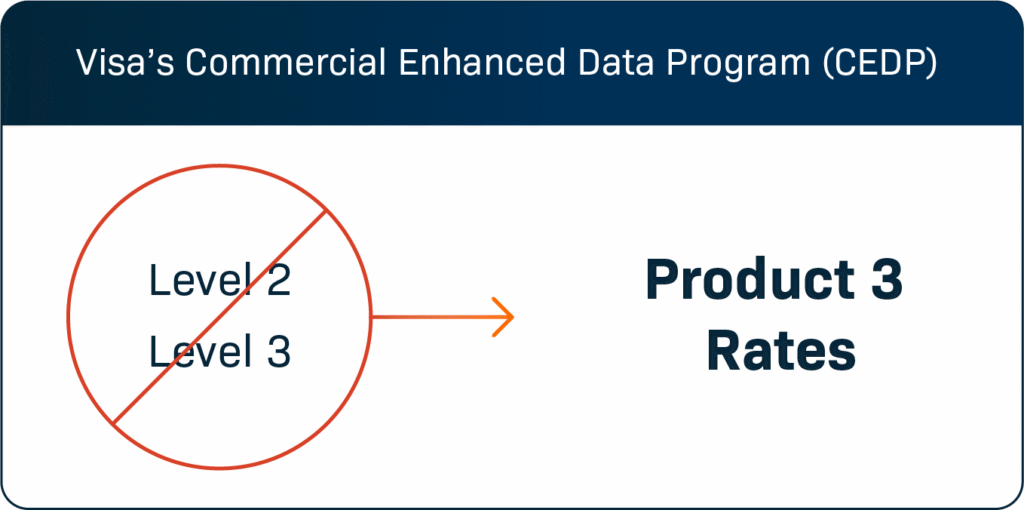
CEDP replaces the old Level 2 and Level 3 structure with a single, standardized validation model, making data quality a direct driver of payment economics.
CEDP Rewards Accuracy—and Exposes Data Gaps

Under CEDP, businesses that submit complete, validated transaction data are classified as verified and qualify for Visa’s Product 3 interchange rates.

  • Verified Product 3 transactions generally qualify in the 1.75%–2.05% range
  • Non-verified transactions typically range from 2.65%-2.95%
  • Even after Visa’s 0.05% participation fee, verified transactions can deliver a 7–10% reduction in interchange costs

Businesses that fail to meet verification requirements continue paying higher rates—while still incurring the participation fee, raising their effective processing costs. The implication is clear: enhanced data is no longer optional. It’s a cost-control requirement.

Why Visa CEDP Matters for B2B Organizations

Visa now validates qualifying transactions in real time, checking for data completeness and accuracy. Clean, consistent data unlocks better rates; gaps or inconsistencies increase costs.

  • Data quality becomes a financial strategy—not just a back-office task
  • Line-item detail, tax, duty, and freight accuracy directly affect interchange
  • Businesses that modernize benefit from lower costs; those that don’t face rising expense and competitive pressure

CEDP makes payment performance transparent—and actionable.

How Fortis Partners Create Immediate Value

ERP and software partners are uniquely positioned to help businesses adapt to CEDP. Through Fortis, partners can embed CEDP-ready payment experiences directly into the ERP systems their customers already use.

1. Built-in Alignment with CEDP Requirements

Fortis provides standardized data models, APIs, and reporting tools that support Visa’s validation standards. Partners can map required fields, enable accurate data capture, and reduce manual processes that introduce risk and cost.

2. Deep ERP and Commerce Integrations

Fortis integrates directly with platforms such as Acumatica, NetSuite, Sage, and Microsoft Dynamics 365 Business Central—so enhanced data is captured at the source.

These integrations help businesses:

  • Auto-populate line-item and tax data
  • Reduce validation errors that lead to disqualification
  • Maintain consistent verification without added operational burden

3. Real-Time Visibility into Interchange Qualification

Partners can give customers insight into which transactions qualify, which don’t, and why—turning data transparency into measurable cost savings.

What the Cost Savings Can Look Like

The difference between verified and non-verified commercial card transactions can be meaningful, particularly at scale.

Verified Product 3 transactions generally qualify in the 1.75%–2.05% interchange range, compared to 2.65%–2.95% for non-verified transactions. That difference reflects how Visa rewards complete, validated transaction data—not negotiated pricing.

For every $100,000 in B2B payment volume, that gap can translate into hundreds of dollars in potential savings. For manufacturers, distributors, and service providers processing large invoice values, the cumulative impact increases as volume grows.

Rather than a one-time adjustment, CEDP turns interchange optimization into an ongoing opportunity. As data quality improves and more transactions qualify as verified, businesses can continuously reduce unnecessary payment costs over time.

CEDP Is a Part of a Broader B2B Payments Modernization Trend

Beyond cost savings, CEDP reinforces a broader shift in B2B finance toward greater visibility, automation, and control. Finance and operations leaders are modernizing payment workflows to reduce reconciliation effort and improve data accuracy across systems.

Visa’s program rewards organizations that invest in clean, connected payment data, making enhanced data the new standard for operational efficiency.

The Fortis Advantage: A Platform Built for What’s Next

Fortis provides the infrastructure partners need to succeed under CEDP and beyond. With standardized data models, developer-friendly APIs, and real-time reporting, Fortis makes it easy to embed CEDP-ready payments into ERP and software platforms.

  • Capture enhanced data automatically
  • Reduce validation failures
  • Qualify for lower interchange rates
  • Improve long-term efficiency and financial control

As CEDP adoption accelerates, early movers will realize measurable savings first. Fortis partners are positioned to bridge the gap between transaction data and payment performance—delivering accuracy, transparency, and confidence at scale.

The Bottom Line

Visa CEDP changes how B2B payment costs are determined, shifting the focus from card type to data quality. Businesses that adapt early can reduce interchange, improve visibility, and strengthen financial control.

With Fortis, partners can help customers meet today’s requirements while building a more efficient, future-ready payments foundation.

Let’s start the conversation about how Visa CEDP fits into your broader payment strategy.
Digital Wallets and the Shift in Payment Expectations Heading Into 2026

Why Modern Payment Experiences Are Now Critical to Customer Retention

As organizations look ahead to 2026, one reality is already clear: customer expectations around payments have permanently changed. What once felt like a competitive differentiator—fast, flexible, digital payment options—has become the baseline. 

Digital wallets such as Apple Pay, Google Pay, PayPal, and Venmo are no longer viewed as emerging capabilities or optional enhancements. They reflect how customers expect digital experiences to work. When those expectations aren’t met, friction shows up quickly—and over time, that friction impacts trust, satisfaction, and retention.

For businesses, software platforms, and ISVs, the strategic implication isn’t about unlocking incremental payment revenue.  It’s about protecting customer relationships by removing moments of friction that quietly erode loyalty. 

Digital Wallet Adoption Reflects Changing Expectations 

Digital wallet adoption continues to accelerate globally, but the real signal isn’t adoption alone. It’s what that adoption says about customer tolerance for friction.  

According to Capital One Shopping, over 4.3 billion people worldwide used digital wallets in 2024, with usage projected to reach 5.8 billion by 2029.  In the U.S., more than half of adults already rely on digital wallets—not because they’re novel, but because they’re faster, simpler, and feel more secure. 

Wallets succeed because they remove effort from the transaction. Biometric authentication, tokenization, and stored credentials allow payments to happen quickly and confidently, without forcing customers to think about the mechanics behind them. 

Payment Expectations Are Retention Expectations 

Digital wallets now account for 53% of global online purchases and 32% of in-store transactions, according to Capital One Shopping. But the more telling insight is behavioral, not transactional: 51% of digital wallet users have stopped shopping with a business that only accepted traditional payment methods. 

This isn’t about preference. It’s about patience—or the lack of it. When payment experiences feel outdated or inconvenient, customers don’t just notice. They interpret that friction as a signal about the organization itself. 

Over time, those signals compound—and churn follows. The payment experience has become one of the most visible drivers of customer retention. 

Why This Shift Matters for Platforms and ISVs 

For software platforms and ISVs, payment experience is inseparable from product experience. As payments become embedded into workflows, any friction at the point of payment reflects back on the platform delivering it. 

Digital wallets are increasingly used for: 

  • Embedded payments within vertical SaaS platforms 
  • Subscription-based B2B purchases and renewals 
  • Mobile invoicing and field-service interactions 
  • Corporate and virtual card transactions 

In these environments, even minor points of friction can trigger outsized consequences—support tickets, delayed payments, abandoned transactions, or strained customer relationships. 

Each issue may seem small in isolation. Together, they erode long-term loyalty. 

The Convergence of eCommerce and B2B Expectations 

Another critical shift heading into 2026 is the convergence of consumer and business payment expectations.  

Today’s business buyers are also consumers—and they increasingly expect the same speed, flexibility, and familiarity in professional transactions that they experience personally. As B2B interactions move toward self-serve, digital-first models, tolerance for rigid or manual payment processes continues to shrink. Digital wallets sit at the center of this convergence. They offer a consistent experience across personal and professional contexts, reinforcing a simple truth: ease is no longer channel-specific. 

For organizations focused on retention, consistency across experiences matters.  Friction in one channel doesn’t stay isolated—it influences how customers perceive the entire relationship. 

Digital Wallets as Signals of Experience Maturity 

Digital wallets are evolving beyond simple card storage. Many now support additional payment rails and use cases. But the strategic insight isn’t about feature breadth—it’s about adaptability. 

Wallet support signals whether an organization’s payment infrastructure is built to: 

  • Reduce effort rather than introduce steps
  • Integrate seamlessly into broader digital journeys 
  • Adapt as customer expectations evolve 

Organizations that lack this flexibility may not lose customers overnight. But over time, misaligned experiences quietly increase dissatisfaction—and attrition becomes inevitable. 

Why Fortis Thinks About Payments Differently 

At Fortis, we see payment experience as a critical extension of the customer relationship—not just a transaction layer. As expectations continue to rise, modern payment strategies must be designed to reduce friction, reinforce trust, and scale alongside customer growth. 

That’s why we focus on helping platforms, ISVs, and businesses align payment experiences with how customers actually want to interact—today and in the future. When payments work the way users expect, they strengthen retention instead of putting it at risk.  

The Bottom Line: Retention Follows Experience 

Retention is no longer driven by individual transactions—it’s shaped by cumulative experience. Payment flows that feel slow, manual, or disconnected from the rest of the journey quietly undermine trust. 

Heading into 2026, the organizations that win on retention will be the ones that remove friction wherever it appears—especially at the point of payment. When payment experiences work the way customers expect, they fade into the background. 

And that’s exactly where they belong.

Let’s start the conversation about how payment experience impacts customer retention. 

Quick Invoice: Get Paid Faster with an Optimized Workflow

Despite gains in digital invoicing, many businesses still struggle to scale their accounts receivable (AR) operations. Manual processes like mailed statements from the AR team or the customer’s accounts payable (AP) department, can cause considerable lag in receiving payments. 

One survey found that 87.6% of businesses in Western Europe faced delinquent B2B payments. Over half of the respondents said that switching from manual to e-invoicing processes resulted in faster payment times. On the customer’s side, AP teams are increasingly concerned about the invoice approval process and find manual review to be an issue.  

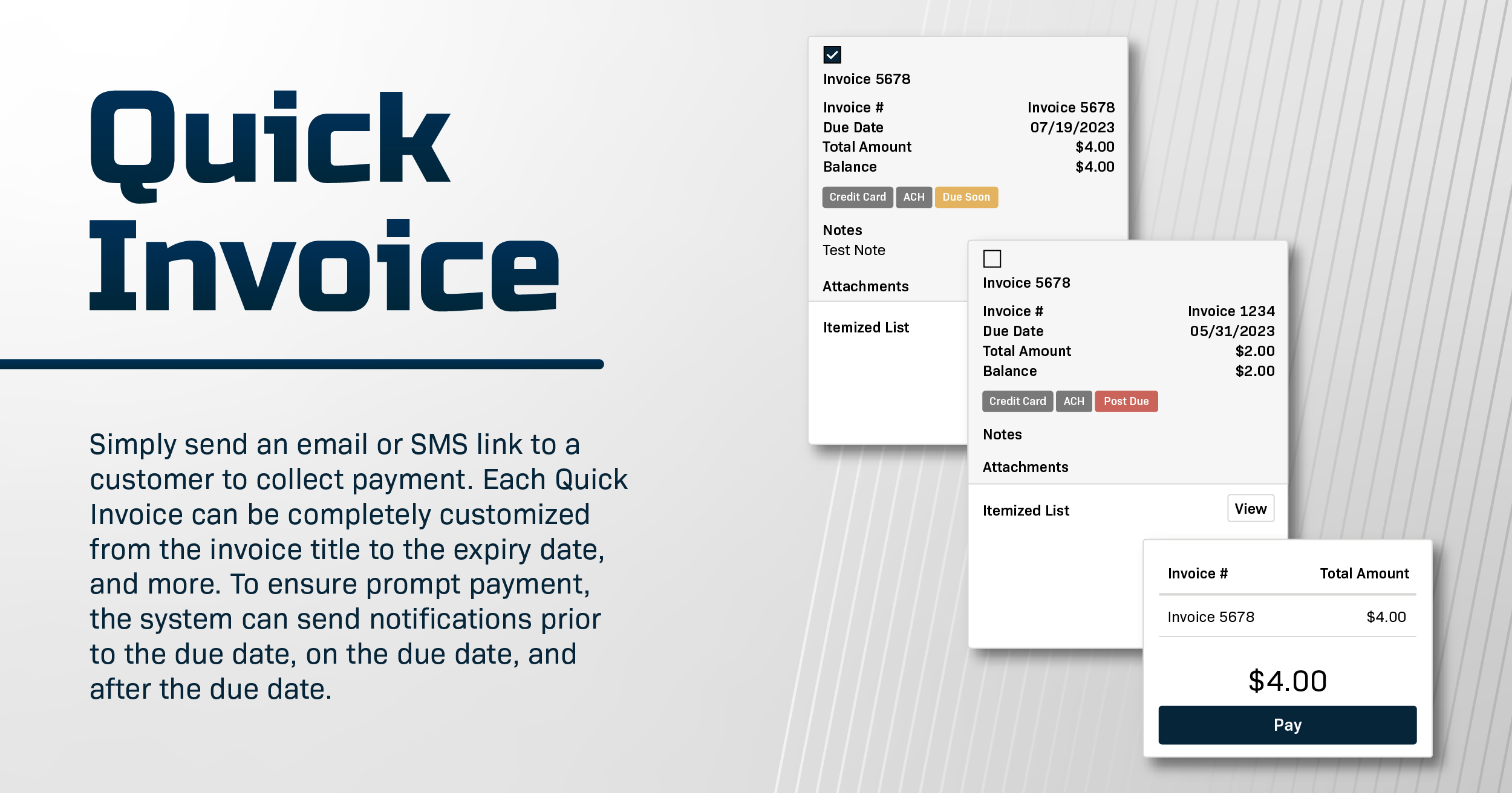
This challenge presents an opportunity for ISVs seeking a competitive edge. A payments platform that enables quick invoicing and streamlines the payment process provides a valuable, high-demand service. Quick invoicing through an embedded payment system allows merchants to send invoices via SMS or email and accept electronic payments. Ideally, the process should be simple and convenient for both the payee and the payor. 

Segment from episode one of Embedded. This demo explains how to leverage quick invoicing within the Fortis ecosystem.

Benefits of Quick Invoices 

Let’s look at some advantages of quick, digital invoicing: 

  1. Create invoices quickly 
  1. Automate reminders before and after the due date 
  1. Allow for overpayment or partial payment 
  1. Offer several payment methods 
  1. Review all past and open invoices from both the payee and payor side 
  1. Pay from multiple devices 

These features benefit both parties. The merchant is able to set clear payment terms and effortlessly send electronic invoices and reminders. At the same time, the customer can quickly review open invoices, choose how to pay based on their preferences, and pay from their phone, tablet, or desktop. Customers can also adjust payments for cash flow fluctuations—such as making a partial payment during low periods and submitting the remainder later.  

A Payments Partner for You  

As the leader in embedded payments, Fortis has developed its payment platform to match the needs of a modern business. Our embedded payment solution empowers organizations to streamline their billing through quick invoicing, automation, multiple payment options, and more.  

To learn more about how you can optimize your payment process, check out our recent Quick Invoicing feature.  

What is a Retained Amount for ISVs?

Service fees for software have come a long way. Software developers continue to evolve and change the way they charge their merchants. For instance, some developers may find it helpful to avoid charging a monthly or yearly one-time fee for their software services, keeping a portion of each transaction instead. Moreover, some would prefer to hold a convenience fee or withhold a donation, but don’t currently have a way to separate the charges from merchants’ transactions. Fortunately, this is where a Retained Amount feature can help. 

How Retained Amounts Work 

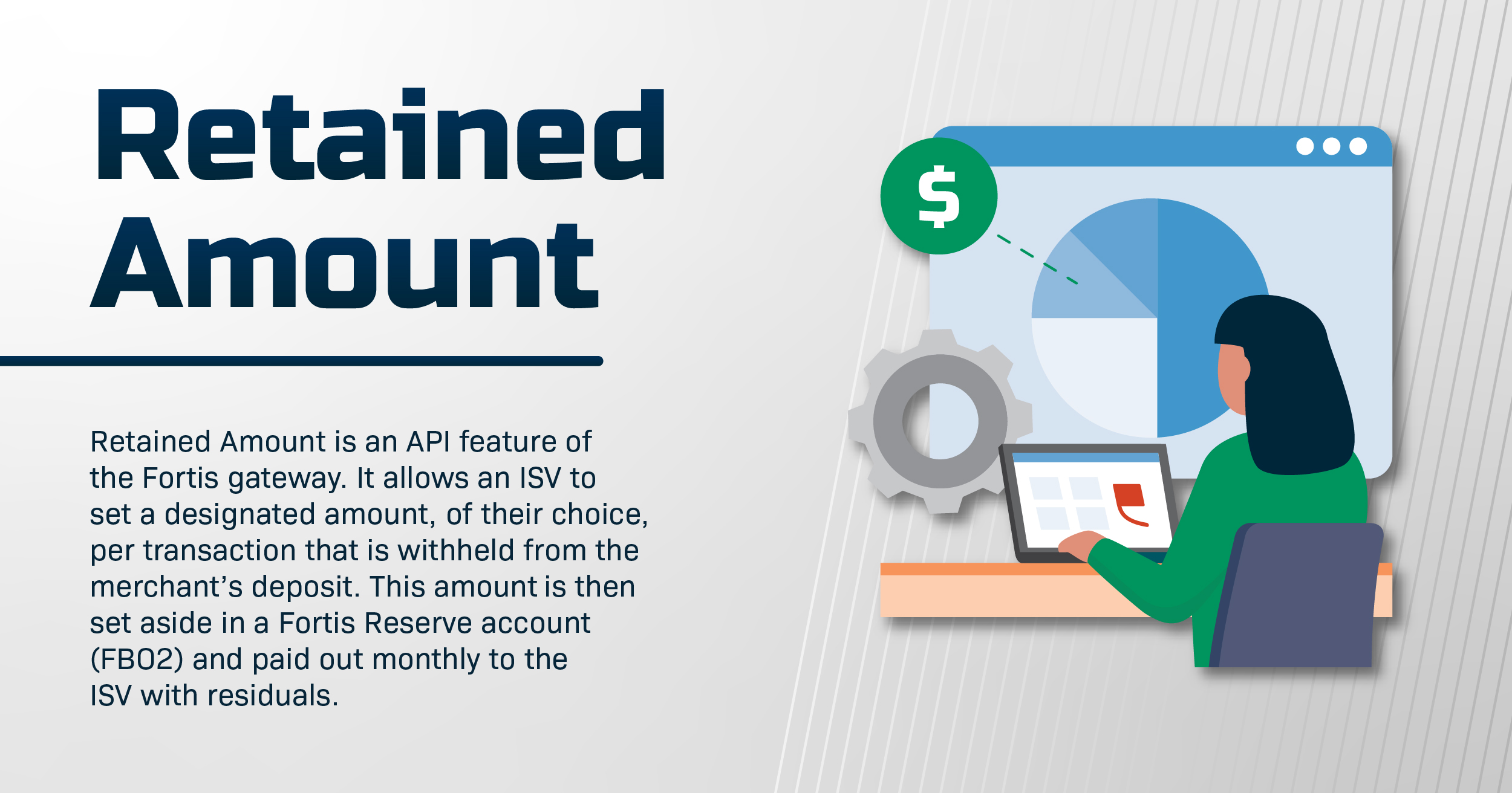
Sometimes called split funding, a Retained Amount withholds a percentage of a merchant’s deposit. The funds are then distributed into two or more bank accounts, which enables ISVs to better segment costs and deduct fees.  

For example, let’s say a merchant receives $100 from a transaction. The ISV’s processing fee is 2%, and they want to reserve an additional 2% from each transaction to cover the cost of the software. That would mean $2 would be used for the processing fee and $2 would be sent to the ISV’s account automatically. In many cases, the ISV has a specific reserved account for these fees and is paid a residual.  

Organizations often leverage this option to refine their payment processing workflow and reduce manual transactions. 

Segment from our first Embedded episode. Kevin, SVP of Product and Innovation, talks about Retained Amount and how it works.

Use Cases for Retained Amounts 

There are a few different ways merchants and ISVs can use the Retained Amount feature, some of which are creative. Outside of general fees, you can use it for: 

  • Donations 
  • Convenience fees 
  • Affiliate rewards 
  • Allowing end-consumers to split a bill 

Despite the many use cases, there are a few drawbacks. Refunds, chargebacks, or determining who pays what fee can be challenging to organize. For that reason, it’s critical to map out a clear vision for the entire payment process and communicate it to both the internal team and end-users.  

The Fortis Difference 

As a leading embedded payments solution, Fortis offers a simple way to streamline Retained Amounts for ISVs and merchants. Our award-winning APIs, sandbox tools, quick onboarding, chargeback management, and enhanced workflows enable you to rapidly customize your payment processes. 

To learn more about Retained Amounts and how you can optimize your payments, speak with our experts today.  

ETA Names Kevin Shamoun of Fortis as Vice Chair of their AI Committee  

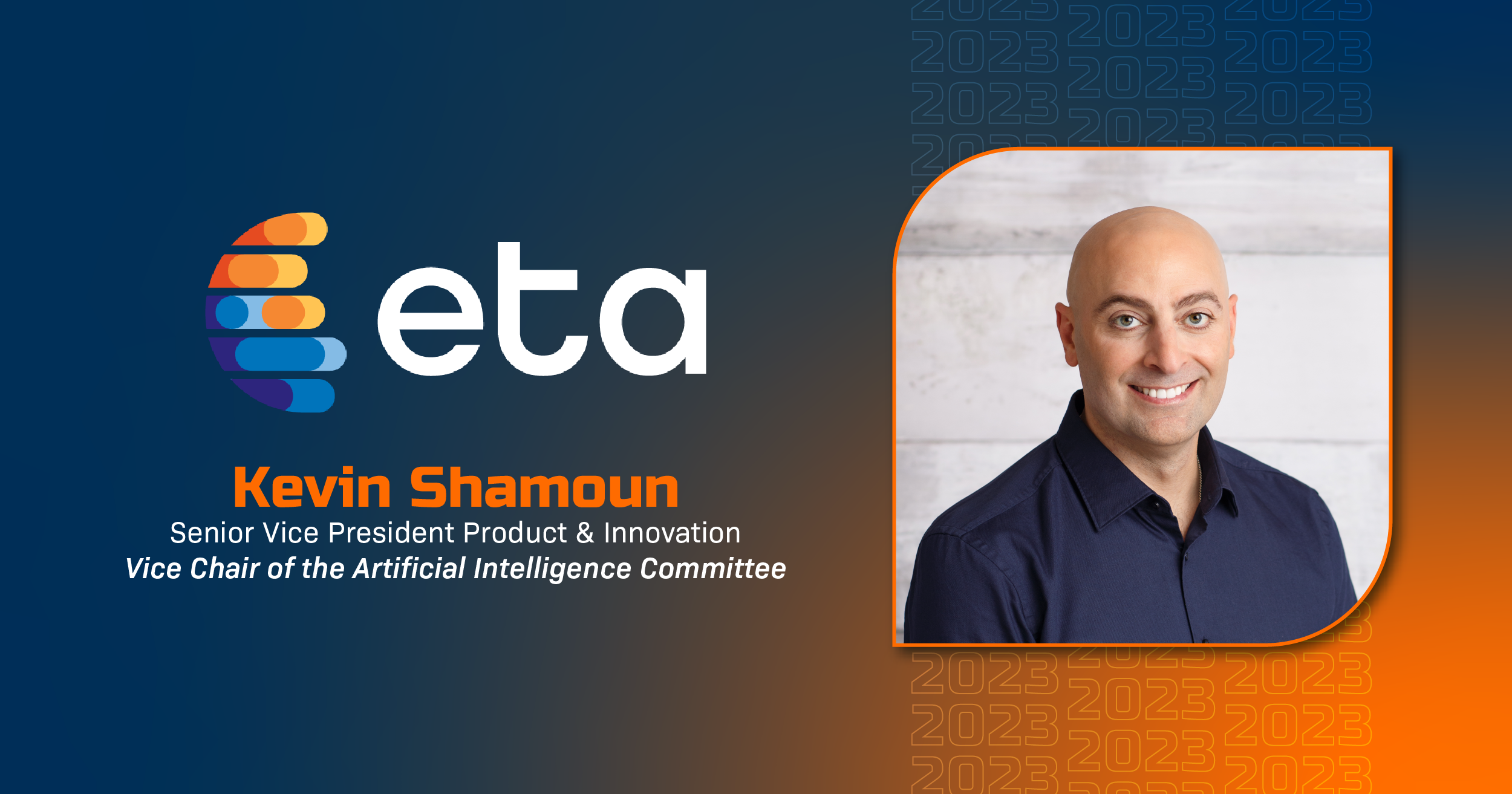
The Electronic Transactions Association (ETA) has named Kevin Shamoun of Fortis as the Vice Chair of their Artificial Intelligence (AI) Committee.

With almost two decades of experience working with Independent Service organizations (ISOs) and financial institutions, Kevin offers extensive experience in the payments industry. He has been responsible for designing, deploying, maintaining, and securing critical systems for multiple organizations.

Kevin is no stranger to leadership roles, as he founded the payment gateway Zeamster in 2019 and already serves as ETA’s Chair of the Technology Committee. His current role at the ETA has allowed him to develop resources for merchants and other ETA members to leverage emerging payment trends. 

As a leading member of the ETA’s AI Committee, Kevin will lend his operational and technical knowledge to explore how the industry can use AI to improve payment efficiency and security. He will work together with Russell Moore, Director of Corporate Strategy & Development, Global Payments, and Donald Riddick, Chief Legal Officer, Featurespace, to better define AI and its use cases with the payment industry.

About ETA 

The Electronic Transactions Association (ETA) is the world’s leading advocacy and trade association for the payments industry. Members span the breadth of significant payments and fintech companies, from the largest incumbent players to the emerging disruptors in the U.S. and in more than a dozen countries around the world. ETA members make commerce possible by processing approximately $44 trillion annually in purchases and P2P payments worldwide and deploying payments innovation to merchants and consumers. 

Why Does PCI Scope Matter to Business Owners?

As a business owner, why should you care about PCI scope? It may not seem important, but it can easily impact your business if you aren’t taking the necessary measures.

What Is PCI?

Payment Card Industry (PCI) Compliance, is “a set of security standards designed to ensure that ALL companies that accept, process, store or transmit credit card information maintain a secure environment” (source). 

PCI Compliance is monitored by the PCI Security Standards Council (PCI SSC). They help to ensure that payment and fintech companies adhere to specific guidelines, practices, and standards to ensure payment data is stored and managed securely.

What Does PCI Scope Mean Exactly?

PCI Scope is what parts of your business environment the PCI SSC determines must meet their guidelines. Since their guidelines deal with the proper storing and management of cardholder data, they consider anything that stores, processes or transmits data as “in scope”.

What Does It Mean to Be Out of PCI Scope?

When you partner with a payment or fintech company that keeps PCI “out of scope”, it means that they take the necessary steps to ensure payment data security for your business on your behalf. 

These companies are required to submit thorough paperwork to the PCI SSC every year demonstrating their compliance. They also partake in annual PCI training and require all employees to be knowledgeable in cardholder data safety practices.

Why Should I Partner With Someone Who Keeps PCI Out of Scope?

Partnering with a payment or fintech company that keeps you out of scope for PCI has numerous benefits, such as:

  • Reducing compliance and operation costs
  • Increase cardholder data security
  • Reducing breach risk and liability
  • Expert knowledge and reliability

Ready to partner with us? Click here.